Showing posts with label Joni Mitchell. Show all posts

Wednesday, June 26, 2019

Cellars And Chittlins'


Joni Mitchell : Goodbye Pork Pie Hat


In June of 1979, Joni Mitchell released Mingus, a collaboration with jazz great Charles Mingus as well as such musicians as Herbie Hancock, Wayne Shorter, Jaco Pastorius and Don Alias. Most Joni fans don't rate this highly among her many albums, but it's certainly the most unique and well worth some attention. For a taste, check out "Goodbye Pork Pie Hat", originally composed by Mingus as a tribute to Lester Young.


To promote the album Mitchell shared her love of jazz with Los Angeles Times jazz journalist Leonard Feather:

My jazz background began with one of the early Lambert, Hendricks and Ross albums, the one called 'The Hottest New Sound in Jazz.' It was hard to find in Canada, so I saved up and bought it at a bootleg price. I considered that album to be my Beatles. I learned every song off of it, and I don't think there is another album anywhere - including my own - on which I know every note and word of every song.


 "I couldn't do 'Cloudburst,' because of the very fast scat singing, but I did record two numbers out of that set: 'Twisted,' which was in the 'Court and Spark' album, and 'Centrepiece,' which was incorporated with 'Harry's House' in the 'Hissing of Summer Lawns' album."


"I was also impressed by some of the Miles Davis albums; first 'Sketches of Spain,' with Gil Evans and the large orchestra; but later, Miles' smaller combo things like Nefertiti' and 'In a Silent Way' became just about my all time favourites in any field of music. They were my private music, the albums I loved to listen to on my own. I never thought about making that my kind of music."


"Mingus was a legend, of course, I'd heard of him as far back as my high school days. Then years later, John Guerin, the drummer, played me a record of Mingus' 'Goodbye Pork Pie Hat,' the elegy for Lester Young, but it wasn't until many years later, when I began to learn the piece for this album, that I really saw the beauty of it."


Mingus had been trying to track down Mitchell after hearing Paprika Plains" from her "Don Juan's Reckless Daughter" album.

 "In the middle of it I had this passage for about seven minutes of improvisational playing. Charles apparently heard in it some kind of strength, and an adventuresome spirit, because I had been trying for years to extend the limits of what constitutes a song."

In April of 1977 Mingus called from a wheelchair with news that he had written six songs with Mitchell in mind. She visited him in New York, talked through the night, listened to old Mingus albums together, and discussed lyrics. 

Mitchell spent ten days with Mingus and wife Sue in Mexico. Out of the relationship came four songs. After Mingus passed at the age of 56, his wife sent Mitchell some audio verite of Mingus which appear as "raps" on the album. 

Here's one of the new Mingus compositions to which Mitchell added lyrics, "The Dry Cleaner From Des Moines".


As Mitchell prepared for the release she told Feather:

"I'd be surprised if it wasn't well accepted in the jazz world, because it contains all the best elements of that music: It's very spontaneous, creative and fresh. As for the pop field, I dare not make any predictions. I hope people will find it accessible, but I know how intimidating great musicianship is to a lot of people."

Even critics had problems with the album, finding Mingus pretentious and Mitchell out of her depths. Robert Christgau gave the albu. a C+ writing "Okay, okay, a brave experiment, but lots of times experiments fail". 

Down Beat's critic, on the other hand,  called Mingus a wonderful piece of work:

From all reports, the trepidation in Joni Mitchell's heart as to how this project might be accepted has been matched only by the skepticism of scores of jazz purists. But the proof is here, and Joni and her critics can forget their fears. Mingus is so ambitious, so painstakingly constructed and so special, that even in those moments when the deed fails, the thought carries the day. And when it all clicks as on "Porkpie Hat", which, after three hearings, I can no longer listen to dry-eyed--it soars with the breadth and majesty Mingus so often achieved.


Thursday, December 14, 2017

Pissed A Tequila-Anaconda


Joni Mitchell : Talk To Me


The most reckless thing about Joni Mitchell's Don Juan's Reckless Daughter, released December 13, 1977,  is her appearance in blackface on the cover, reprising a Halloween costume she wore earlier in the year, going as a black man who complemented her on an L.A. street 

“As he went by me he turned around and said, ‘Ummmm, mmm... looking good, sister, lookin’ good!’ Well I just felt so good after he said that. It was as if this spirit went into me. So I started walking like him,” Mitchell said. “I bought a black wig. I bought sideburns, a moustache. I bought some pan- cake makeup. It was like ‘I’m goin’ as him!’”

The double album has enough jazz inflected moments to please fans of Court and Spark and Hissing of Summer Lawns, and the album did sell enough to go gold. But the reviews were not kind, including the one below by Rolling Stone's Janet Maslin who called it "an instructive failure".


In retrospect, Blue turns out to have been the album that displayed Joni Mitchell at her most buoyant and comfortable — with herself, with the nature of her talents, and with the conventions of pop songwriting. From that happy juncture, she has moved on to more graceful and sober self-scrutiny (For the Roses and Court and Spark), to dramatic musical experimentation mixed with failed social commentary (The Hissing of Summer Lawns), to ever-more-seductive singing (Miles of Aisles) and to rambling, hypnotic flights of fancy (Hejira). She has dabbled with jazz and African tribal music, ventured deep inside herself and fled far away. But, always, the unpredictable caliber of her work has been as exciting as it is frustrating. Now, for once, she has gambled and lost. The best that can be said for Don Juan's Reckless Daughter is that it is an instructive failure.

 Since Blue, Mitchell has demonstrated an increasing fondness for formats that don't suit her. Not that this awkwardness can't be occasionally successful: on Hejira, she clung so resolutely to even the stray flat notes that the impression was an attractive one of stubbornness and strength. But, increasingly, Mitchell's pretensions have shaped her appraisal of her own gifts. At her best, she is a keen observer but not a particularly original one, and she has never been an interesting chronicler of experience other than her own, though the new LP finds her trying. Instead, she has been inexplicably inclined to let her music become shapeless as she tries to incorporate jazz and calypso rhythms that eventually overpower her. Her most resonant lyrics have been simple and concise, spinning out images rather than overburdening them, but lately the endearing modesty of "California" or "Just like This Train" seems far behind her. These days, Mitchell appears bent on repudiating her own flair for popular songwriting, and on staking her claim to the kind of artistry that, when it's real, doesn't need to announce itself so stridently.

 Don Juan's Reckless Daughter is a double album that should have been a single album. It's sapped of emotion and full of ideas that should have remained whims, melodies that should have been riffs, songs that should have been fragments. At its worst, it is a painful illustration of how different the standards that govern poetry and song lyrics can be, and an indication that Joni Mitchell's talents, stretched here to the breaking point, lend themselves much more naturally to the latter form. Her writing works best when it's compact, yet the record's expansive mood forces her to belabor, in the title song, the precious contrast between a snake (or a train, as well as the author's baser instincts) and an eagle (or an airplane, plus a longing for "clarity") for nearly seven minutes. Mitchell's music has evolved into a kind of neutral background, rolling on endlessly in either a languid spirit ("Jericho") or a nervous one ("Dreamland"). Somehow, she has chosen to abandon melody at a time when she needs it urgently.


 The painful banality of Mitchell's lyrics — there is nothing said here that she hasn't said better before, except those things she should have kept to herself — is almost the least of her problems. Behind a treacly title like "The Silky Veils of Ardor" lurks an even treaclier notion: that the romantic visions of love put forth by certain folk songs are one thing, that reality is another, and that the singer apparently yearns for both. "It's just in my dreams we fly," the song concludes, with a reference to "The Water Is Wide." Or, as a dialogue balloon on one of the inner sleeves puts it, "In my dweems we fwy." The album offers what is, one can only hope, the ultimate in cute cover art.


It also offers the ultimate in potshots: "Otis and Marlena," a facile, snidely sung song about tourists who come to Miami "for fun and sun While Muslims stick up Washington." This leads into "The Tenth World," a mostly instrumental percussion track featuring Jaco Pastorius (who plays on a majority of the record with distinction, but without much helpful influence), Airto and Chaka Khan (who hums). Here and elsewhere, there seems to be the notion that blacks and Third World people have more rhythm, more fun and a secret, mischievous viewpoint that the author, dressed as a black man in one of the photos on the front jacket, presumes to share. On the numbing, sixteen-minute "Paprika Plains," we also learn about Indians, who "cut off their braids/And lost some link with nature." 

"Talk to Me" is the LP's most enduring number: as a terrible, embarrassing song about feeling terribly embarrassed, it has a scary appropriateness. But even though there are no real solutions to the album's mysteries or explanations for its lapses, Joni Mitchell's resilience has been demonstrated often enough to make speculation about such things appear superfluous. She's bound to be back when the time is right and her mood is less drowsy, less disengaged than it seems here. Until then, we're left with Don Juan's Reckless Daughter, in all its recklessness.


Friday, November 25, 2016

The Last Waltz


The Band : Up on Cripple Creek


On Thanksgiving night in 1976, at San Francisco's Winterland, The Band called it quits in the biggest way possible --with an all-star concert celebration starring Bob Dylan, Eric Clapton, Bobby Charles, Paul Butterfield, Emmylou Harris, Joni Mitchell, Ringo Starr, Neil Young, Ron Wood, Muddy Waters, Van Morrison, Dr. John, Ronnie Hawkins and the Staples. Oh, and for some reason, Neil Diamond. Movie director Martin Scorsese filmed the farewell concert, which was billed as The Last Waltz.  

In his recently released memoir, Testimony, guitarist Robbie Robertson writes about the moment they launched into "Up On Cripple Creek", the first song of the night:

The sound on the stage felt powerful and clear. Levon was knockin' on wood -- his drums were punching right through Garth's electric jew's harp sound and my rumbling guitar tone. We were all adjusting to the altitude and finding our footing. I looked over at Rick and Richard, and they were both in the zone. Levon's vocal was strong and authentic, and he did the yodel section at the end of the song with a grit I'd never heard before. Okay. This was it, I let go of the rope and never looked down.


Thursday, November 24, 2016

Black and Ragged


Joni Mitchell : Black Crow


My life has totally reoriented itself around one center : music. It is in me and around me, always. I couldn't even have children because it would interfere with my work.
-Joni Mitchell, 1976


Released in November of 1976, Joni Mitchell's Hejira is one of the great road albums, a travelogue of her heartbroken wanderings and wonderings with the amazing Jaco Pastorius performing bass on five tracks. Mitchell has been on the road constantly, touring with Bob Dylan's Rolling Thunder Revue, an experience that left her exhausted. That was followed by a solo road trip of the United States, in which she wore a red wig and stayed in hotels under a false name. ("I'm so glad to be on my own" she sings on the title track). The album was written on a guitar that I imagine was stuffed in the back seat.

The highlight for me might be "Black Crow", in which Joni sees herself in a black crow diving down to pick up shiny things. Mitchell's own observation about Hejira might be the best: "the poet took over the singer".


Billboard, 1976:

The magical, hypnotic singing and songwriting style of Mitchell here gets one of its most fully-rounded, deepest-conceptualized workouts yet. The sound is purely distilled Joni: the high, ethereal voice; the slightly eerie chord tunings and Mitchell's rolling guitar arpeggios; the increasingly inventive use of spare, jazzy rhythm combo backings. The melody lines swirl and cascade like oriental tapestry patterns as Mitchell's voice smoothly fits seemingly impossible-to-sing lyric phrases into a distinctive music.

The underlying idea here that holds together the songs and the surrealistic black-and-white cover photography is that of the wanderings of a free-spirited female who must always look back half-yearningly at the chances for lasting security she has passed up.

A key image song in the LP development is "Black Crow," where the singer compares herself to a bird always "diving down to pick up on every shiny thing." Her cover photo costume emphasizes this black-wing look, along with other song images of the endless highway, childhood ice skating and dreams of the pertect marriage. Best cuts: "Blue Motel Room, " "Black Crow," "Song For Sharon," "Coyote," "Hejira."


Robert Christgau :

Album eight is most impressive for the cunning with which Mitchell subjugates melody to the natural music of language itself. Whereas in the past only her naive intensity has made it possible to overlook her old-fashioned prosody, here she achieves a sinuous lyricism that is genuinely innovative. Unfortunately, the chief satisfaction of Mitchell's words -- the way they map a woman's reality -- seems to diminish as her autonomy increases. The reflections of a rich, faithless, compulsively mobile, and compulsively romantic female are only marginally more valuable than those of her marginally more privileged male counterparts, especially the third or fourth time around. It ain't her, bub, it ain't her you're looking for. B+


Village Voice Pazz and Jop Critics Poll

1. Stevie Wonder: Songs in the Key of Life (Tamla) 292 (25)
2. Graham Parker and the Rumour: Heat Treatment (Mercury) 234 (22)
3. Jackson Browne: The Pretender (Asylum) 232 (22)
4. Graham Parker and the Rumour: Howlin' Wind (Mercury) 215 (19)
5. Kate and Anna McGarrigle: Kate and Anna McGarrigle (Warner Bros.) 208 (16)
6. Steely Dan: The Royal Scam (ABC) 182 (14)
7. Joni Mitchell: Hejira (Asylum) 169 (16) 
8. Ramones: Ramones (Sire) 153 (15)
9. Rod Stewart: A Night on the Town (Warner Bros.) 150 (15)
10. Blue Oyster Cult: Agents of Fortune (Columbia)


Tuesday, August 23, 2016

40 Year Itch : Jaco


All of us stand on Jaco's shoulders. - Sting

Jaco Pastorius : Donna Lee


In August of 1976, 25 year old Jaco Pastorius released his self titled debut album. Pastorius reinvented the bass. He plucked off the frets and created the warmest, most resonant, most expressive voice in the world of jazz. He played the bass as though it were a lead instrument, using harmonics in a way most people had never heard. He was, as his wife told Blood Sweat and Tears drummer Bobby Colomby, "the greatest bass player in the world".


Colomby agreed. He produced the debut album with one goal in mind : "to bring Jaco to as many people as humanly possible". Jaco Pastorius is not a traditional jazz album. The second track, the funky "Come On, Come Over", features the vocal talents of Sam and Dave. Herbie Hancock performs on six of the nine original tracks.


 In the tremendous documentary, Jaco, Hancock says Jaco was able to handpick whoever he wanted to work with. A surprising number of 1976 albums would illustrate that remark. He played bass on Ian Hunter's All American Boy, on debut albums by both Pat Metheny and Al DiMiola, on two tracks of his future band, Weather Report's Black Market ( including Joe Zaniwul's tribute to Cannonball Adderly), and most significantly perhaps, on Joni Mitchell's Hejira.


No discussion of Jaco's brilliance can end without painfully discussing his battle with mental illness and alcoholism. In the Jaco documentary, Flea relates the story of coming across a homeless looking musician in New York City's Washington Square. And then this sad image appears on the screen : the world's greatest bass player playing for spare change.


Sunday, November 29, 2015

40 Year Itch : Hissing of Summer Lawns


   The immediate critical evaluation of 1975's Hissing of Summer Lawns was not kind. Rolling Stone declared the album the worst of the year, and suggested that Joni Mitchell had both run out of melodic ideas and gave too much room for the "cliche-ridden" support of Tom Scott's L.A. Express.

   So I was surprised when my step brother suggested he dub a CD copy of the album for me. And even more surprised how, over time, I've come to enjoy the album as much anything in the Joni repertoire barring Blue.


The lyrics are full of an artist's arched eyebrow-ed observations of suburban life:

  He bought her a diamond for her throat 
He put her in a ranch house on a hill 
She could see the valley barbecues 
From her window sill 
See the blue pools in the squinting sun 
Hear the hissing of summer lawns


  Some of the jazz sounds dated, but there are also slices of world music on the album --like the Burundi drums on "The Jungle Line", presaging Echo and the Bunnymen's live Burundi drummer collaboration "Zimbo" by seven years.


  Hissing of Summer Lawns may be one of the best reminders that an album that divides critics is worth our attention. Time has proved Joni was right all along. And if we need further proof, no less an expert than Prince has called Hissing his favorite all time album.


SOUNDS ALBUMS 1975 critics poll
1. The Hissing Of Summer Lawns - Joni Mitchell
 2. Blood On The Tracks - Bob Dylan
 3. Natty Dread - Bob Marley And The Wailers
 4. The Who By Numbers - The Who
 5. Still Crazy After All These Years - Paul Simon
 6. Caught Up - Millie Jackson
 7. Back To The Night - Joan Armatrading
 8. Nils Lofgren - Nils Lofgren
 9. Visions Of The Emerald Beyond - Mahavishnu Orchestra
 10. Hot! Menu! - Sadistic Mika Band

Tuesday, April 22, 2014

40 year itch: Joni Plays London


On April 22, 1974 Joni Mitchell wrapped up her first 1974 tour with a three night stand at the New Victoria Theatre in London. All of the shows sold out. The final night was filmed by the BBC's Old Grey Whistle Test. The performance would air in November.

Back in the US her album Court and Spark was making itself at home in the Billboard Top 10 album chart. 

Among those who attended the show was George Harrison. It was backstage that Harrison met Tom Scott and impulsively invited Scott and the LA Express to record at his mansion the next day. The results were two forgettable tunes that would appear on  Dark Horse : the instrumental "Hari's On Tour" and "Simply Shady".


In September Joni would return to London where she would perform with Crosby Stills Nash and Young at Wembley Stadium


The entire April show in faded color.

Monday, January 20, 2014

40 Year Itch: Passport Smiles


"The first truly great pop album of 1974" 
-Jon Landau, Rolling Stone

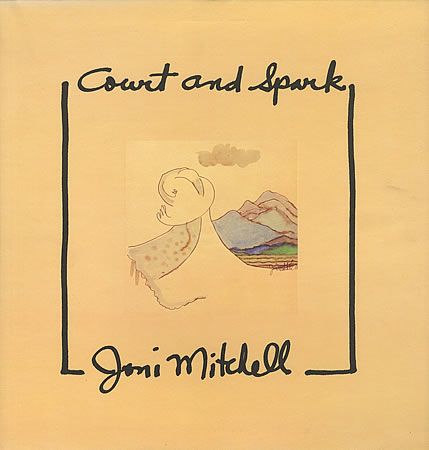
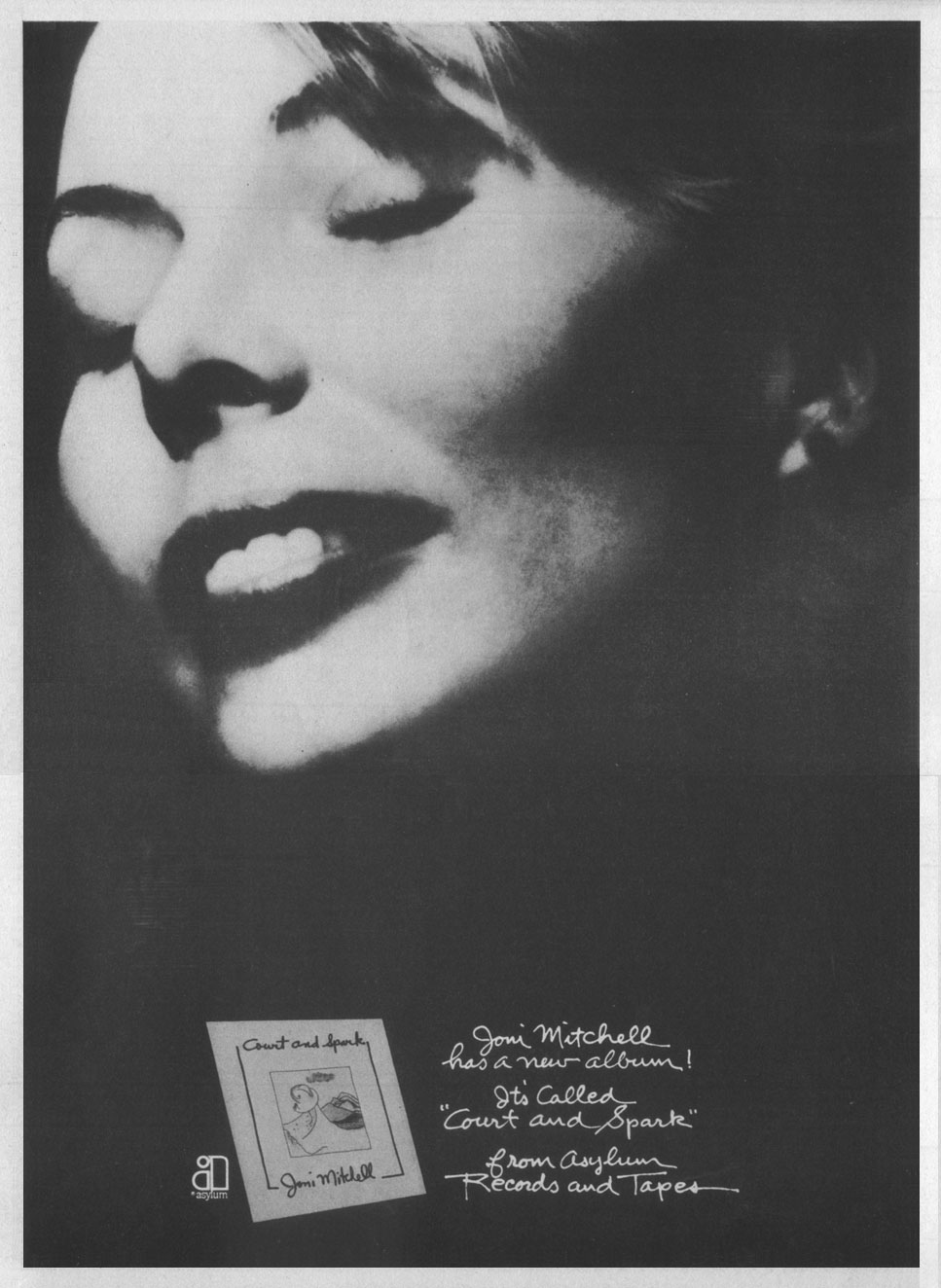
 On January 17, 1974 Joni Mitchell released her sixth, and arguably best, studio album, Court and Spark, to widespread critical acclaim and the best sales of her career. The double platinum album would be voted the best of the year by the Village Voice Pazz and Jop Critics Poll edging out Steely Dan's Pretzel Logic for the honor.
 

    At the time, critics didn't make such a big deal of Joni pairing up her amazing voice with jazz instrumentation. Robert Christgau goes so far as to say:

The first album she's ever made that doesn't sound like a musical departure -- it's almost standard rock.


   That's because anyone who had heard her criminally underrated 1972 album, For the Roses, already knew where she was heading. (Just listen to "Let The Wind Carry Me"). On Court and Spark Tom Scott, who played woodwinds and reeds on Roses, returnsed with his studio band The L.A. Express. The band included a good looking jazz drummer named John Guerin.


The hit single, "Help Me",  is the story of Joni and John's instant infatuation with each other.

  In Girls Like Us Sheila Weller quotes Guerin:

"Joan was a different kind of animal," he said. She created. "A lot of " what he fell in love with " had to do with her out-and-out-talent . I was amazed at her talent for most of our relationship. She didn't have patience for repetition or rules. I never paid attention to lyrics before ; I listed to a singer's timbre or phrasing or the quality of her voice. Boy, she changed that for me! She opened up my ears to words."


There's a pretty simple reason why this is the best selling and most critically acclaimed album in the Joni Mitchell catalogue: it's her most appealing. The pop songs are straight-forward; the love songs touching; and Joni even reveals her sense of humor on the first single "Raised on Robbery" and, with the help of Cheech and Chong,  her cover of the Lambert-Hendricks-Ross novelty tune "Twisted".


The only critic who didn't love Court And Spark was label mate Bob Dylan who pretended to fall asleep when she played it for him. It may have been a joke since their boss David Geffen was in the room but it's something for which Joni has never forgiven Dylan.


Saturday, January 18, 2014

40 Year Itch: A Folk Waif Rocks Out


  On January 18, 1974, a day after the release of Court and Spark, Joni Mitchell hit the road for the first time in a couple of years, opening her nine month tour of the US and London at Kiel Auditorium in St. Louis, Missouri. The show began with some jazzy instrumentals from Tom Scott and the LA Express, the session men who played on Court and Spark.   


     Then Joni came out in a low cut dress. After accepting a bouquet of roses which she placed in a vase onstage, Joni explained they nearly missed the show because of the weather. "There was this strange fog formation, and when we got about ten feet above the ground, we saw it was a highway we were about to land on and not the runway. So we flew back to Cincinnati."

      Yes, the pilot actually turned the crazy bird around.


       So naturally, she opened with "This Flight Tonight". Then they went into the basic concert set. They played "Free Man in Paris", "You Turn Me On I'm A Radio", "Woodstock",  and "Raised On Robbery" among others. 

Among those at the show was Concert Magazine reporter Don Ross:

Vocal communication between the audience and the artist continued all night (Joni encouraged it) and, when the band returned, one person expressed his disapproval - "play without the band!" To some Joni Mitchell freaks, the backup, electric sound came across too heavy for the delicate emotions that flowed through her songs and their souls. And sometimes the arrangements differed on the older material and this displeased them; the last tune before the break was "Woodstock" and it had already been rearranged once by Crosby, Still, Nash and Young. Tom Scott and the L.A. Express set it to a jazzy beat and, while Joni Mitchell felt at home within the flow, it left some people with a feeling of alienation during the intermission. But once the band was given a chance again, "play with the band" issued froth from another part of the audience.


    After an intermission, Joni came out by herself to play "Cactus Tree" , "Big Yellow Taxi" and the Court and Spark cut "The Same Situation". Then she sat down with her dulcimer for two Blue cuts : "A Case of You" and "All I Want". Back at the piano she played "Blue" and "For Free" before the band returned for the latest single, "Raised on Robbery", "Trouble Child", "Both Sides Now" and the encore, "Twisted".

   It was too soon to know this would be Joni's year. By year's end, she'd have her first Top 10 hit ( "Help Me" ( US#7) and be featured on the cover of Time Magazine. Also, strangely, The New York Times would do a concert review titled "Rock and Roll's Ethel Merman".


Tuesday, November 27, 2012

40 Year Itch: On Butterflies and Lilac Sprays


In Kicking And Dreaming, Nancy Wilson tells the story of searching for Joni Mitchell on Sechelt Island off the British Columbia coast. This is years before she became famous herself. Nancy had read that Joni owned an 80 acre farm on the 15 square mile island. The journey proved fruitless. Islanders who could have pointed the way usually sent Nancy in the opposite direction.


Though I can't prove it, I always felt I recognized the backdrop of Joni Mitchell's For The Roses. It couldn't be anything but an island on the Sunshine Coast, a slightly sunnier cousin of Washington's San Juan Islands. And the nude gatefold pretty much seals the deal.


But enough about the cover. Released in November of 1972, For the Roses offers a transition between the stark instrumentation of 1971's classic Blue and the Tom Scott/ soft jazz explorations of 1974's Court And Spark. While it may be some people's favorite Joni Mitchell album, For the Roses doesn't work for me anywhere near as well as the two albums surrounding it. Naturally there are songs that sounds like Blue ( "Banquet", "For The Roses") and those that sound like Court and Spark ("Barangrill" and the US#25 hit "You Turn Me On ( I'm A Radio)" which even gives us a glimpse into the forthcoming boho hit "Help Me").


Two of the more interesting cuts, at least to me, are "Blonde in the Bleachers" and "Cold Blue Steel and Sweet Fire". The first one may very well be a message to Graham Nash about those "sweet mysteries" groupies offer but about my half way in it becomes a message to groupies about Graham Nash and all of the other rock n roll men:
 You can't hold the hand Of a Rock'n'Roll man
 Very long
 Or count on your plans With a Rock'n'Roll man 
 Very long 
 Compete with the fans For your Rock'n'Roll man 
 For very long
 

 And the astonishing lyrics of "Cold Blue Steel" relate an urban nightmare from the perspective of a junkie:
 A wristwatch, a ring, a downstairs screamer 
Edgy-black cracks of the sky "Pin-cushion-prick- Fix this poor bad dreamer!"


  For The Roses isn't the first Joni Mitchell album you should buy, but you're missing out if you ignore it altogether.

Sunday, June 24, 2012

40 Year Itch: Our Bodies, Ourselves


1972 was an odd year for artists who wanted to bare more than their souls on record.
 Here are eight of the most, um ,  interesting examples.


CAETANO VELOSO : ARACA AZUL

I don't go to Caetano Veloso for odd, avant garde experimental sounds. Not when he can deliver albums like Transa. I guess I'm not alone. Araca Azul has established itself as the Brazilian Metal Machine Music. It's not that bad  but, really, what music fan in his right mind--or her right mind-is going to walk up to the register with an album that looks like this?


BRAINSTORM : SMILE A WHILE

Brainstorm recorded a highly entertaining mix of krautrock/prog/jazz-rock that may remind some of the Canterbury scene. Not sure anybody has explained why the band dressed up in ladies undergarments for the cover. I guess to make you smile a while?


TERRY CALLIER : WHAT COLOR IS LOVE
[Purchase]

Obviously this isn't Terry Callier on the cover but I'm not going to pass up an opportunity to write about Terry Callier. I got into the Terry Callier appreciation club later than most, via Beth Orton's 1997 Best Bit EP. Callier has a soulful voice and plays a sweet acoustic guitar but so do Bill Withers and Richie Havens. Callier also adds tasteful, borderline cheesy in some cases, jazz instrumentation. In 1972 he made What Color Is Love, an album as beautiful as the woman posing on the cover.


THE EDGAR WINTER GROUP: THEY ONLY COME OUT AT NIGHT

The Edgar Winter Group's They Only Come Out At Night features the #1 million selling instrumental "Frankenstein" and the #4 single "Free Ride" as well as a shirtless cover of Winter wearing jewelry so elaborate it would embarrass the Queen of England.


JEAN-CLAUDE VANNIER : L'ENFANT ASSASSIN DES MOUCHES

From, Jean-Claude Vannier,  a French producer and arranger who worked closely with Serge Gainsbourg comes L'Enfant Assassin Des Mouches,  a big budget no holds barred album that promises to overload the auditory senses with its mix of symphonic rock , huge choruses and sound effects. I think that's Vannier posing on the cover photo which suggests a completely different kind of album.


JONI MITCHELL : FOR THE ROSES

Long before there were hidden tracks on CDs, Joni Mitchell offered a hidden photo of herself, in the nude, on the inside cover of her gold album  For The Roses. Although Wikipedia's entry suggests she's looking out upon the ocean, I'd say this is more likely The Strait of Georgia, off Vancouver Island. But I can't prove it. This is the album in which Joni begins exploring some of those jazz sounds with Tom Scott which would lead to such highs as Court and Spark and The Hissing of Summer Lawns and lows like the live album Miles of Aisles and a few others I'm too polite to name.


CHRIS SMITHER : DON'T DRAG IT ON


The great Duane Michals took this shot of Smither, a singer-songwriter who Bonnie Raitt called "my Eric Clapton" Despite her championing Smither hasn't had the best of careers but this album, recorded at Bearsville Sound Studio in Woodstock,NY, has a great feel to it and belongs in your "I must listen to this really soon" pile.


ANALOGY : ANALOGY

Analogy was a German psychedelic band based in Italy whose female vocalist was apparently not hired for her singing talent.